The team behind Mimir AI impressed judges with a conversational AI agent that makes complex banking APIs easier to use for large corporate customers. But the story is not only about the solution itself. It also shows what can happen when people from different backgrounds come together to tackle a challenge.
A hackathon built for learning and creating
Now in its third year, the GenAI Hackathon has become one of the largest innovation events in Danske Bank.
This year's edition brought together 465 colleagues across 75 teams, making it the biggest GenAI Hackathon. Over three days, participants explored how generative AI could help solve real business challenges, building working solutions on top of the bank's shared AI foundation.
The event was designed to be accessible to colleagues from different professional backgrounds. Participants received onboarding sessions and training before the hackathon, and worked with tools such as Amazon Bedrock, Amazon AgentCore, Danske Bank's own Agent Builder Toolkit and more. This allowed both technical and non-technical participants to quickly turn ideas into functioning AI solutions.
During the event, teams created more than 230 AI agents and generated over 51,000 AI interactions, demonstrating how quickly ideas can evolve when people are given the right framework and support.
A team assembled by chance
Some participating teams entered the hackathon with an advantage: they already worked together, knew their business area well, and combined expertise from technology, design and business. The team behind Mimir AI had a different starting point.
The four colleagues signed up individually and were grouped together shortly before the event. Their assigned challenge, related to Premium APIs for Large Corporates & Institutions (LC&I), was also outside their day-to-day area of expertise. This gave the team an opportunity to approach the challenge from a fresh perspective.
The team spent time understanding the problem, talking with stakeholders, and exploring how the new AI tools available during the hackathon could help.
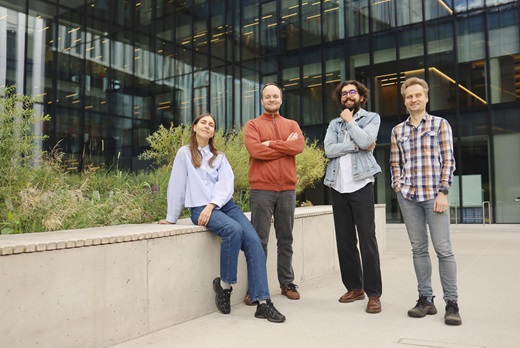
The winning team: Kristina Puidokaitė, Software Engineer; Justinas Kelmelis, Senior Business Analyst; Dovydas Ramašausas, Senior IT Software Engineer; Jurgis Latonas, IT Software Engineer
The moment everything clicked
Initially, the team assumed they would need to build much of the solution themselves. Then they had what they describe as a "eureka moment": “We realised the goal wasn't to build everything from scratch, but to make the most of the tools available to us."
This reflected the spirit of the hackathon itself: work smarter, not harder. Instead of spending days writing code, they used the AI tools provided during the event to build and refine their solution. By orchestrating existing AI capabilities, they created a working prototype of Mimir AI in just a matter of days, showing how quickly good ideas can become tangible solutions when the right technology is in place.
.png?h=122&w=250&rev=dba4eb45db9b483d87773c704033ebef&hash=C6E86C37B97D4827F45FA23617FA804B)
Within days, the team had built Mimir AI, a conversational assistant that allows corporate customers to interact with Premium APIs using natural language. Through a single chat interface, users can access account balances, initiate payments, execute foreign exchange transactions, and find documentation without needing to navigate complex technical interfaces.
Why did this solution stand out
The judges evaluated submissions based on four principles: relevance, responsibility, reliability, and reusability. Mimir AI scored highly not because it attempted to solve the biggest possible problem, but because it solved a real one in a practical way.
The solution demonstrated how AI can simplify a complex user experience and make sophisticated services more accessible. Just as importantly, it was built with scalability in mind. The team designed the concept so the same approach could potentially be reused across many different API-based services in the future.
More than a competition
For the winning team, the result came as a surprise.
.png?h=140&w=250&rev=1bbd7c502041487fb4b802f2e869ff0a&hash=C7AD5B13D1F984C31782F9A03ECCC4FF)
"We never expected to reach the finals, let alone win the hackathon," the team says. "Throughout the competition, we learned so much and the entire experience was truly incredible. It's mind-blowing to see what can be crafted with AI in such a short amount of time."
Their experience reflects the broader purpose of the GenAI Hackathon. Beyond creating prototypes, the event gives employees an opportunity to explore emerging technologies in a practical setting, learn from one another, and test ideas that could help shape future banking services.
As the story shows, innovation does not always start with deep expertise in a specific area. Sometimes it starts with curiosity, a willingness to learn, and the opportunity to build something new together.

